"KING COTTON" - Until the 1920s, south Arkansas relied primarily on an agricultural economy. The 1918 census reveals that over 80 percent of the people lived on farms.
"TIMBER" -
The timber industry
experienced enormous growth between 1870 and 1909. By the 1920s Arkansas was ranked
sixth
in U. S. lumber production.
"THEY CAME IN DROVES" - When oil was discovered in 1921, people came by the thousands to the oil fields. They packed into passenger cars, hung from the windows, rode the rails and perched precariously on car tops.
| CENTER OF THE EARTH EXPERIENCE |

This inside out experience shows the world's oil and brine fields.
A circular corridor, seemingly bored through layers of rock, represents exit from the earth's core to the surface. The oversized drill hole leads through the various geological strata beginning with the Louann Salt at 8,000 feet in depth and continues to the earth's surface.
The Organic Theory of oil formation is graphically presented in a series of exhibits including a Geologic Time Scale.
A focal point of this gallery is the fossil exhibition featuring specimens found in south Arkansas that date back thousands of years.
The laboratory setting serves as a pre-show holding area for the experience ahead. A brightly backlit graphic states: "JOURNEY BACK 200,000,000 YEARS."

![]()
| TWO HUNDRED MILLION YEAR VOYAGE IN TIME |
UNDERSEA DIORAMA AND TIME VOYAGE - When it is time to embark, elevator doors open and visitors enter the high-tech environment of a time capsule.
As the doors close and the lights dim, a voice-over explains that the visitor will voyage back in time, beginning on the bottom of the ancient Jurassic sea. This magnified view of ancient sea life exhibits the true creatures that led to the eventual formation of oil.
The ocean darkens and a diorama on the opposite wall comes into view. The time clock, now at the 1880s, still flashes forward through the Industrial Revolution era. The space comes alive with activity, engines roar, horns honk, tires screech . . .the age of the automobile is at hand. There is a sudden crashing sound! And . . . . .silence.

![]()
| HISTORY AND NEED FOR OIL |
DOORS OPEN AND THE VISITOR EXITS THE TIME MACHINE. THE TIME IS 1922. IT IS NIGHT.
One stands on the upper veranda of the Rogerson Hotel which faces Smackover's boom town street. Buildings are alive with the warm glow of street lights.
This gallery is composed of three large exhibit cases set in a semicircular layout. The story of the History and Need for Oil is presented including early drilling methods and common uses of petroleum during the late 1800s and early 1900s.

![]()
| IT'S A GUSHER ! |
Having viewed the boom town street from the hotel balcony overlook in the previous gallery, visitors descend the curving stairs.
As they make their descent, they hear a distant rumbling sound slowly building in intensity. Men are shouting, "It's gonna' blow!" The yells continue as the rumbling builds to a crescendo until the gusher finally blows.
Stepping off the final stair, the visitors stand atop a derrick floor. Oil appears to be dripping off of everything as two roughnecks (cast-from-life figures), battle the earth's pressure as they attempt to tie off the gusher.

![]()
| BOOM TOWN STREET |
Two major buildings are on the right-hand side of the street: the Rogerson Hotel and the American Theater.
Attached to the hotel is a rough plank structure that simulates the entrance into Mrs. Murphy's Boarding House which proudly advertises that it has more cots and less mice.
Piano music spills
from the open door of the theater which offers an audio-visual presentation focusing on
the Arkansas petroleum industry.
Crossing the street over the toll plank or weaving between trucks that crowd the 1920s thoroughfare, the visitor can view exhibits in the Smackover Journal newspaper office, the city jail, oil field supply store, and the Horseshoe Cafe.
Visitors may enter the back alley of the Boom Town Street either directly from the Discovery gallery or through the jail's back door, which will lead the visitor to the Goat Woman's Circus Carriage
![]()
| THE CHANGING INDUSTRY |
You
enter this gallery
through a corrugated tin shed with wood plank flooring. Exhibit panels interpret the
expansion of the Arkansas oil industry from 1922 through modern times. The shed also
contains various tools found in such a building in the oil field.
Leaving
the shed and entering the gallery proper, one will be immediately drawn to a display of
antique gas pumps and colorful signs as a backdrop.
The floor appears to be the packed soil of a back road in the Smackover oil field. In the middle of this space one will find a mechanical interactive exhibit which allows one to become the power source for a sucker rod pump. When you turn the crank you get an opportunity to see what's happening below ground as the pump pulls "oil" up to the surface.
![]()
| OIL FIELD EXHIBIT PARK |
Located on five
acres adjacent to the Education Center, the Oilfield Park includes seven operating
examples of the oil producing methods used in the south Arkansas Oil Field from
the
1920s through today.
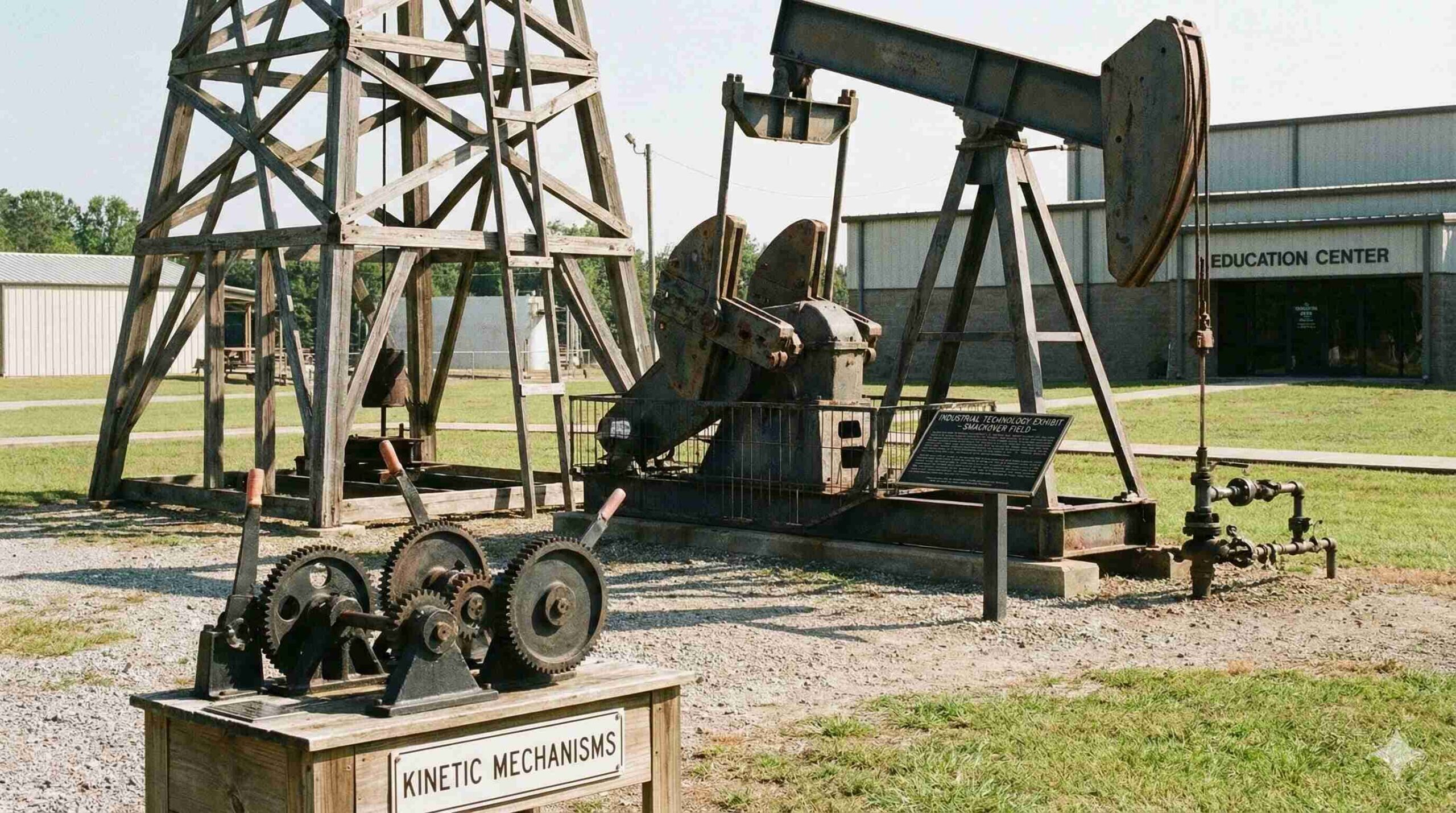
*A 1920S STANDARD RIG WITH A 112' WOODEN DERRICK AND A BATTERY of wooden storage tanks. This exhibit serves as an example of the earliest production process used in Arkansas' oil fields.
*1920S-1930S 64' PIPE DERRICK AND GEAR DRIVEN PUMPING UNIT. Depicts the evolutionary process in derrick use and production methods.
*1930S-1940S
CENTRAL POWER STATION. This building contains an eccentric wheel powered by a 45 H.P.
Reid engine.
*1930S
"GIN POLE" DERRICK AND OKLAHOMA PUMP JACK.
Located adjacent
to the central power
station, it typifies the necessity of "balancing" central power well sites.
*1930S-1940S 87' ANGLE IRON DERRICK WITH PENNSYLVANIA-TYPE PUMP JACK. This well operates from a series of rods connected to the central power source.
*MODERN PRODUCTION UNIT. A Lufkin production unit sits atop an original wellhead and is counterbalanced by 2,125 feet of "down hole" equipment.
![]()
|
TRAVELING CIRCUS |
The circuses, carnivals, chautauquas and traveling shows provided welcome entertainment for oil producing communities like Smackover. Meet Rhene Salome Miller Meyers (The Goat Woman), Smackover's most illustrious and interesting character.

![]()
|
FAMILY LIFE IN OIL FIELD CAMPS |
|
|
|
|
Over fifty major oil company camps were located within the Smackover oil field. This vast community formed the backbone of south Arkansas oil industry from the 1920s-1950s.
![]()
|
OIL FIELD STORAGE AND TRANSPORTATION |
|
|
|
Thousands of steel tanks and vast earthern storage pits were utilized to store the enormous amounts of oil being produced from the Smackover oil field.
![]()
|
MODERN DRILLING |
|
|
|
|
|
Watch a typical drilling operation in progress and take control of your own destiny by actually drilling for oil! Who knows? You might even become a millionaire!